
Italy to Sicily by train: Taking Europe's last train-ferry
Did you know that there’s a train in Italy that goes on a boat? The train from Italian cities like Milan, Rome and Naples to the toe of Italy and then over the sea to Sicily is one of the most unusual rail journeys in Europe, because for part of it, the train itself is on a boat.
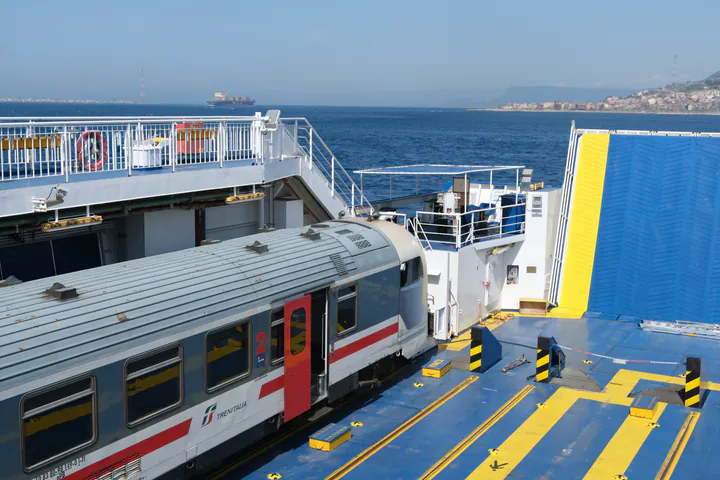
Direct trains cross from the Italian mainland to the island of Sicily at Villa San Giovanni. The train splits in half, is loaded onto a ferry, sails across the Strait of Messina, and carries on its journey on the other side. It’s the last train journey like this left in Europe, and one of a dwindling number worldwide, so a very special experience.
I took the daytime train from Naples to Sicily in April 2026. This guide covers exactly how it works, what the crossing is really like, and what to know before you book.
At a glance
- The direct Naples to Sicily train that I took runs via a train ferry across the Strait of Messina. You can also take a train from Milan or Rome.
- It’s the last regular passenger train ferry crossing left in Europe.
- You can take a direct train from the Italian mainland to Palermo in the north of Sicily and Taormina, Catania and Syracuse on the eastern coast of the island.
- Both a daytime Intercity and an overnight Intercity Notte (sleeper or couchette) cover the route.
The train ferry might sound like a novelty for tourists, but it isn’t; it’s simply how the train reaches Sicily from the Italian mainland. There’ve been plans for a bridge across the strait for decades but nothing has come of it so far, although construction may finally start in late 2026.
I wanted to do the crossing in daylight, so I took the morning Intercity service from Naples, heading for Taormina on the eastern side of Sicily. Here’s how the Italy to Sicily train actually works, what the crossing itself is like, and everything you need to know to plan, book and enjoy your trip.
Contents
How the Naples to Sicily train works
Trenitalia runs direct Intercity trains from the Italian mainland straight through to Sicily, with no need to change trains, book a separate ferry ticket, or sort out your own boat transfer; one ticket gets you on in Rome or Naples and off in Sicily.
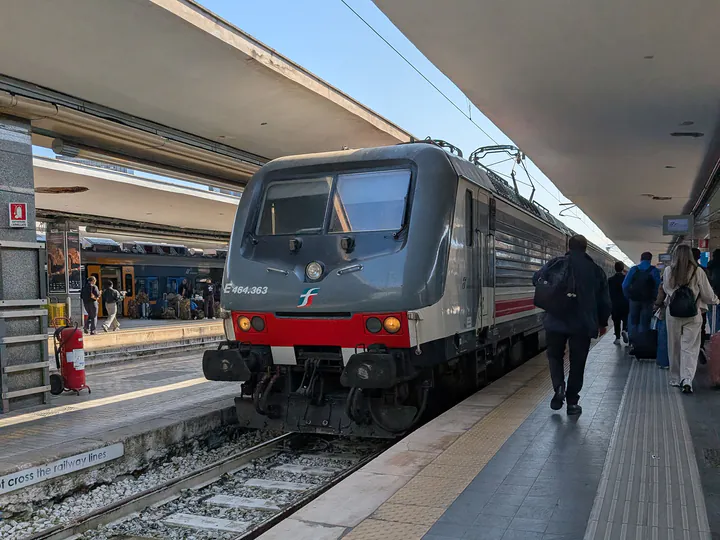
The train splits in two just after the ferry crossing. One portion continues along the northern coast of Sicily to Cefalù and Palermo, the other heads south-east to Taormina, Catania and Syracuse. Both halves travel together as far as the ferry crossing, but you’ll be given a seat in the right part of the train for your journey. The only time it really matters is when you get back on after making the crossing; if you choose the wrong carriage you’re going to end up going in the wrong direction.
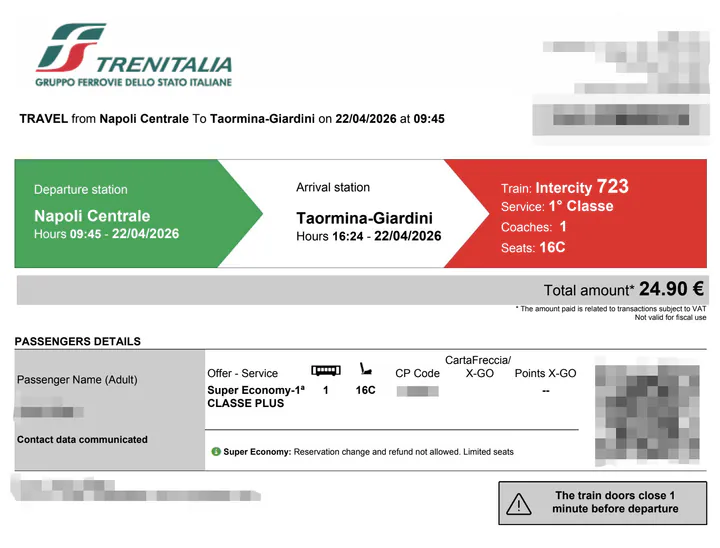
The only other time you’ll need to pay attention is when boarding the train. I was going to Taormina and expected to see Siracusa on the departure board in Naples, but it only showed Palermo. It showed Intercity 723 as the train number though, and that matched my ticket, so I knew we were on the right train.
How long does the train to Sicily take?
There’s no getting around the fact that it’s a long journey, even from Naples, but we’re doing this for the experience, right? Here’s how long the train takes to get to its destination in Sicily.
| Starting point | Destination | Duration (daytime train) | Duration (sleeper train) |
| Naples | Palermo | 9 hours 19 minutes | 10 hours 40 minutes |
| Naples | Catania | 7 hours 24 minutes | 9 hours 7 minutes |
| Naples | Syracuse | 8 hours 52 minutes | 10 hours 28 minutes |
| Rome | Palermo | 11 hours 32 minutes | 12 hours 59 minutes |
| Rome | Catania | 9 hours 43 minutes | 11 hours 26 minutes |
| Rome | Syracuse | 11 hours 11 minutes | 12 hours 47 minutes |
| Milan | Palermo | 14 hours 28 minutes with one change at Naples | 20 hours 45 minutes |
| Milan | Catania | 12 hours 55 minutes with one change at Naples | 18 hours 22 minutes |
| Milan | Syracuse | 14 hours 8 minutes with one change at Naples | 19 hours 38 minutes |
Are there any high speed trains?
Yes and no. You can speed up the journey a little by taking a high speed train down to Villa San Giovanni but for the full train on a boat experience you’ll need to catch one of the two departures from Villa San Giovanni to Sicily with no changes.
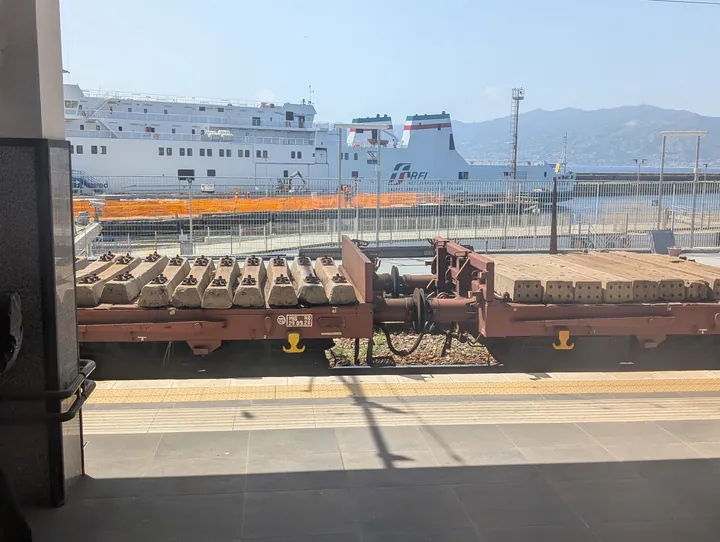
If you’re leaving from Naples or Rome, the timetables don’t currently add up for that to make sense; if you’re coming from Naples you’d actually need to leave Naples earlier if you take the faster train versus the normal Intercity. Coming from Rome, you’d spend the time you’ve saved waiting around at Villa San Giovanni.
If you’re travelling from Milan, then it definitely makes sense to catch a high speed train and then connect to the Intercity in Naples.
What it costs
Like lots of trains in Europe, it pays to book early. I booked in January to travel in April and paid €24.90 for a daytime first class ticket from Naples in mainland Italy to Taormina in Sicily. Coming from the UK that’s an insane bargain for 7 hours in a first class seat and a bucket list experience!
For the daytime Intercity train where you sit in a normal carriage in a normal seat, second class fares start from around €19.90 if you book ahead, rising to a fixed walk-up fare of roughly €80. First class starts from about €29.90, with a walk-up fare of around €115.
If you’d rather travel overnight, the Intercity Notte has three tiers: a shared four-berth couchette from around €39.90 per person, a shared sleeper compartment from around €49.90 to €59.90 depending on how many beds you split it between, and a private single sleeper from around €84.90. Trenitalia’s own site, or agents like Trainline and Italiarail, will show you exactly what’s available for your date.
How to book
This is the important bit if you’re looking to not just get to Sicily but travel on the boat train. For this trip it’s a good idea to book on the Trenitalia website as it shows all the details and there’s an option to avoid changes, which is what you want if you’re travelling from Rome or further south.
You can put the Trenitalia site into English, but station names in the dropdowns to choose your departure point and destination are still in Italian, so for example look for Napoli, Roma, Milano and Siracusa rather than Naples, Rome, Milan or Syracuse.
When you first search, you’ll see all the options for your trip but some of them include changes. Any trip with a change (apart from the option from Milan with a high-speed train to Naples) means you won’t get to see your train go on the ferry. You can use the “Without changes” filter to get rid of those options.
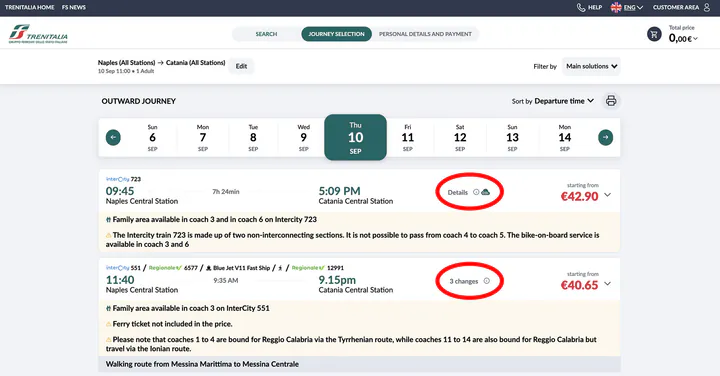
I recommend booking ahead for cheaper prices but it’s worth being aware that these trains do often sell out, even outside peak tourist season; mine was completely sold out in both first and second class.
You can either choose a seat or have one assigned to you, but there are no indications on the seating plan for which direction you’ll be facing, which side of the train you’ll be on, or even if you’ll have a window. It boggles my mind that train reservation systems are still like this in 2026 (even for scenic trains – looking at you Bernina Express).
Unfortunately I made the worst possible choice with my seats and ended up facing backwards, on the wrong side of the train for the lovely coastal views and even if I had been on the right side of the train, there was no window at my seat. I spent a lot of the journey hanging out at the end of the carriage trying to get photos!
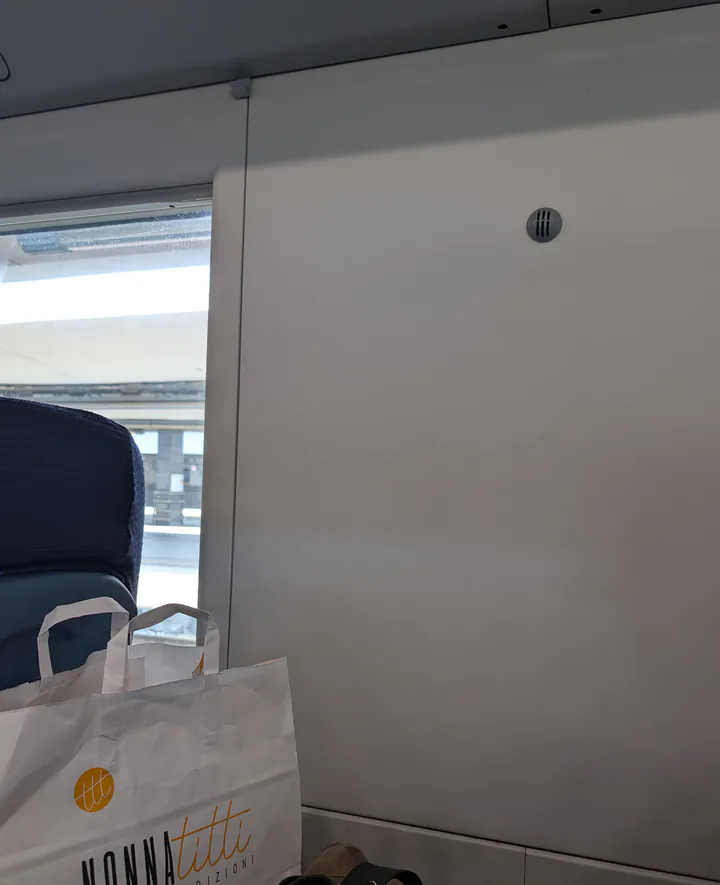
Our seats were 16 D and E, so definitely don’t book those, but looking at the seat plans for the next few months it seems like the carriage layout has changed. For the best chance of a view I think it’s best to book a seat on a table. For my journey, the first class seats with a view of the coast were on the single-seat side of the train, and odd-numbered seats were more likely to have windows.
The train splits at Messina, but you’ll be automatically booked into the right part of the train going on to either Palermo or Catania/Syracuse.
My train ran on time, but that’s not always the case. I’d recommend building a bit of a time buffer into any plans you have after arriving in Sicily.
What it’s like on the train
I took a daytime train from Naples to Sicily, so this is all based on my own experience. My friend Steph from Big World Small Pockets wrote about taking the sleeper train from Rome to Palermo, so check her site out too if you’re planning an overnight journey.
Seats
Apart from facing backwards and the lack of view (sorry, I’m still not over it!), my seat itself was fine. It was comfortable for the long trip and had good leg room. Seats in first class are arranged 2+1, with single seats on one side of the carriage. Seats in standard class are 2+2 but they still looked comfortable.
Service in first class was limited to someone coming round just after departure handing out hand wipes – you’re paying for a comfier seat and a bit more space, not Orient Express-style luxury.
Bring your own food and drink
You shouldn’t rely on being able to get something to eat or drink on either the train or the ferry. There’s no at-seat catering or restaurant car on the daytime trains, just a set of vending machines for light snacks and drinks. On my train you could use cards, notes or coins to pay, but some are coin-only, and they don’t always work, so you absolutely must bring your own food and drink.
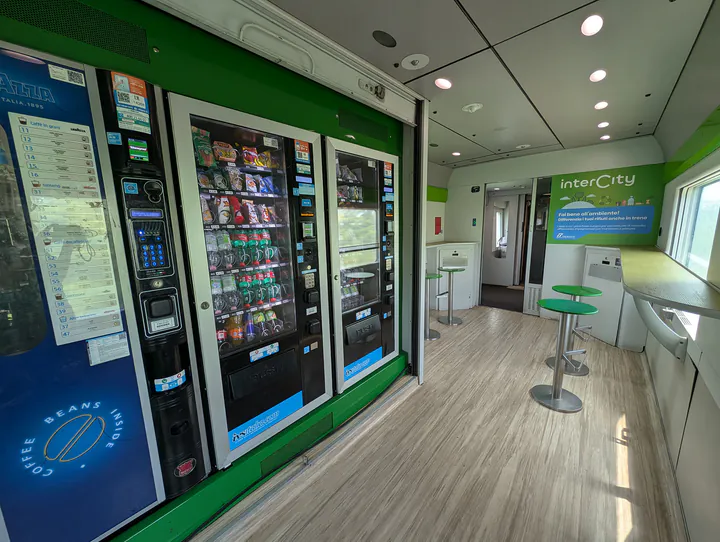
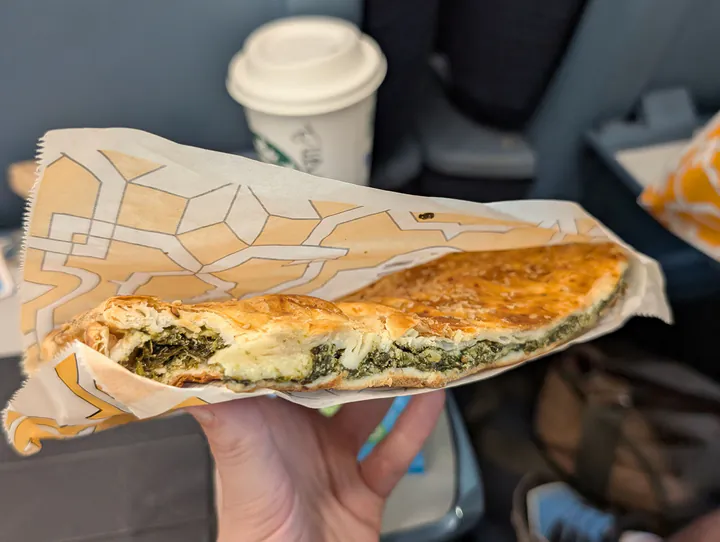
We stocked up on sandwiches, drinks and snacks before leaving Naples; there’s plenty of choice in and around the station.
There’s a cafe on the ferry, but it’s a really short crossing and the queues can be long so you may not have time to get something to eat or drink. I’ve heard from readers that it doesn’t always open.
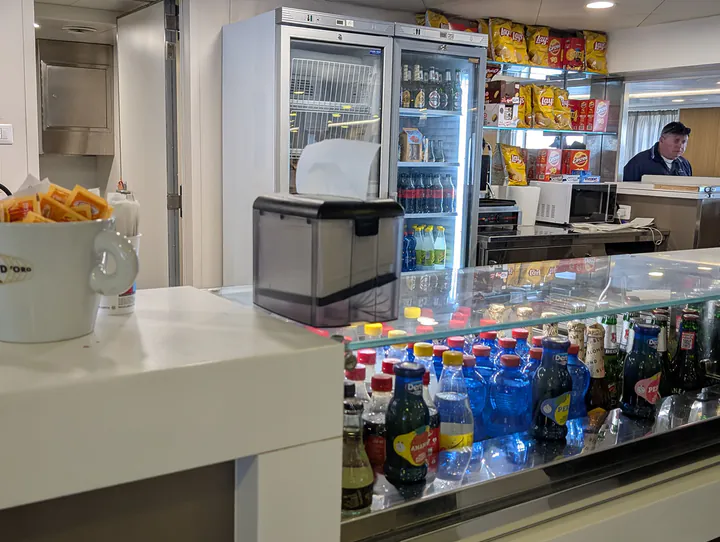
Sleeper train tickets include a light breakfast and in theory there’s a trolley service, but I’d still bring some food and water.
Toilets
There are toilets on the train. They do get a bit grim after a few hours so antibacterial hand gel and wipes are a good idea. There are also toilets on the ferry.
Wifi and mobile signal
There’s no wifi on the train but the mobile signal is ok for most of the route. Bring a book or download some entertainment on your phone before you set off.
Power sockets
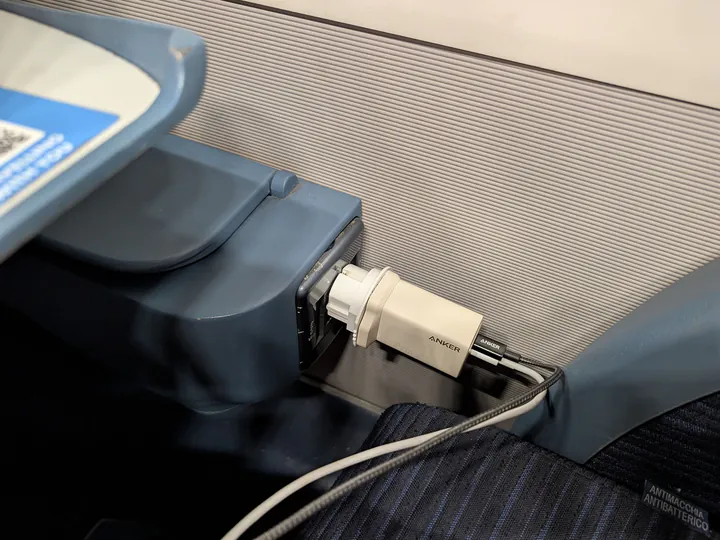
We had a power socket at the seat. One of our EU plug adapters fit, the other one with slightly wider prongs didn’t. If you have a power bank then I’d bring it.
Luggage
Almost everyone on the train will have luggage, and it doesn’t all fit into the racks available. If at all possible, pack light. A carry on bag will fit into the racks above your head. There were loads of huge suitcases on my train which people had abandoned in the aisles and which ended up rolling into other passengers’ legs. Please don’t do that!
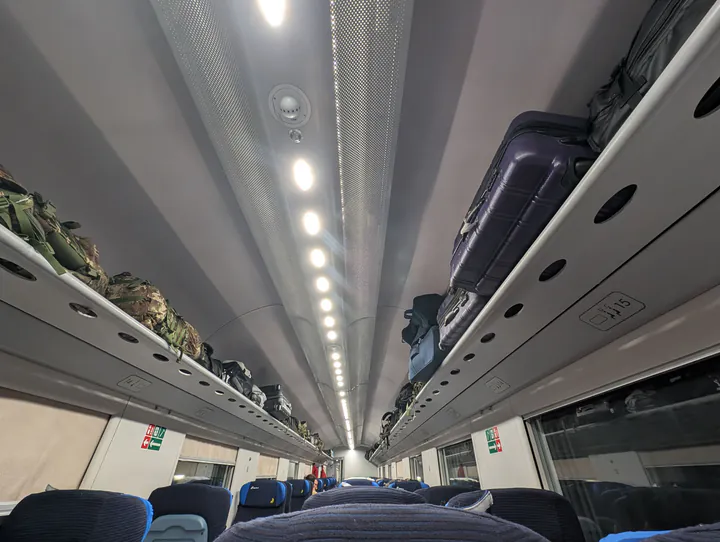
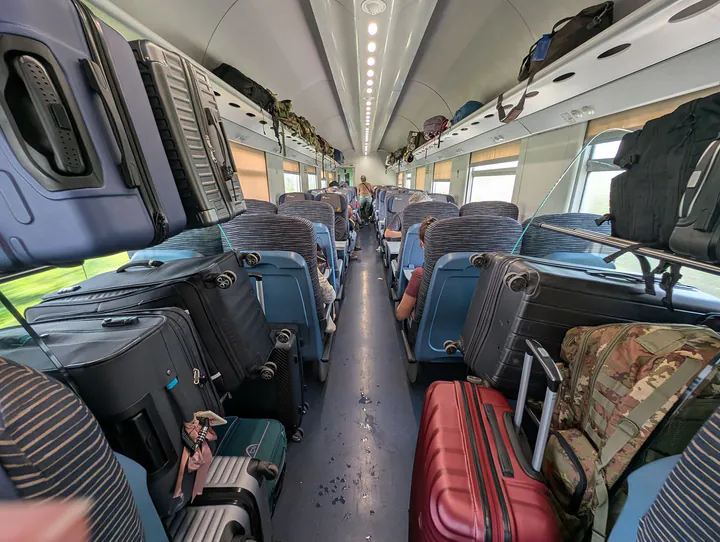
If you get off the train for the ferry crossing, make sure you take all your valuables with you and don’t leave anything important unattended on the train.
The journey down to Villa San Giovanni and the Strait of Messina
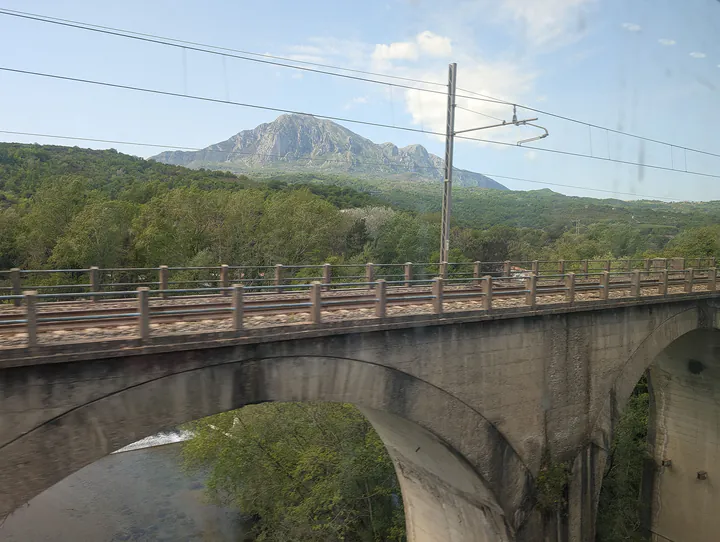
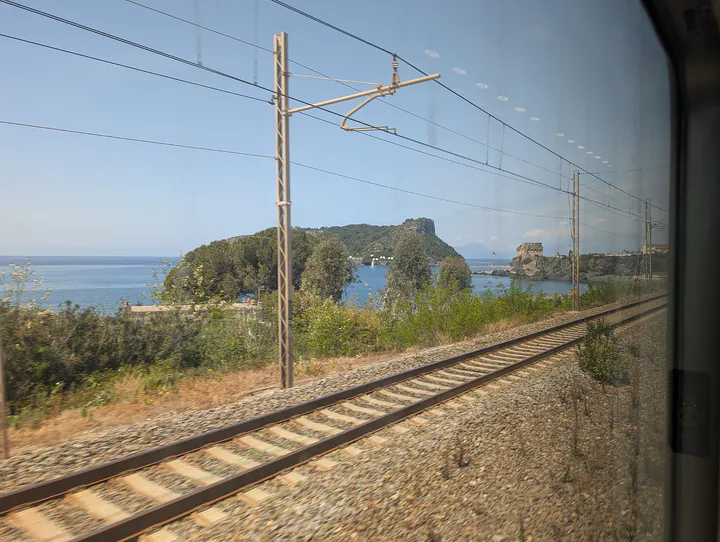
The trip down to the Strait of Messina at the ‘toe’ of Italy’s boot is surprisingly scenic. South of Salerno, the train line runs through the southern Apennines mountain range with dramatic hills and mountain villages. Further down, the railway hugs the eastern coast of Calabria, passing sandy beaches, coves and little islands.
Please forgive my blurry photos taken through the dirty train windows, it really was very pretty!
How the train gets onto the ferry at Villa San Giovanni
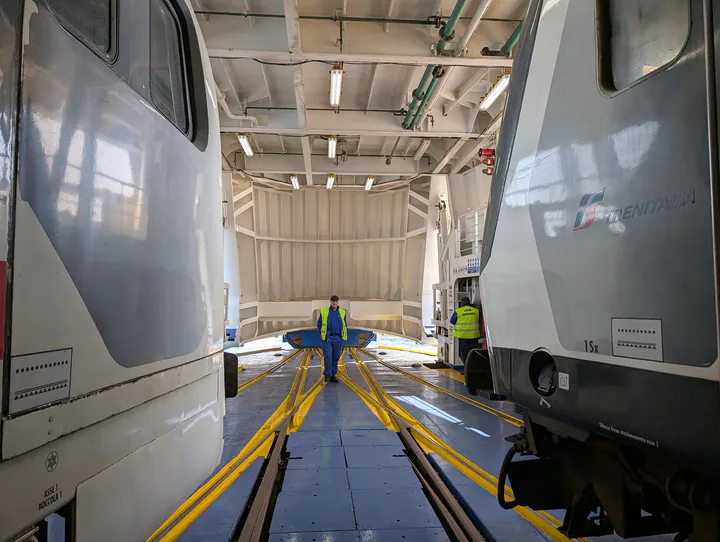
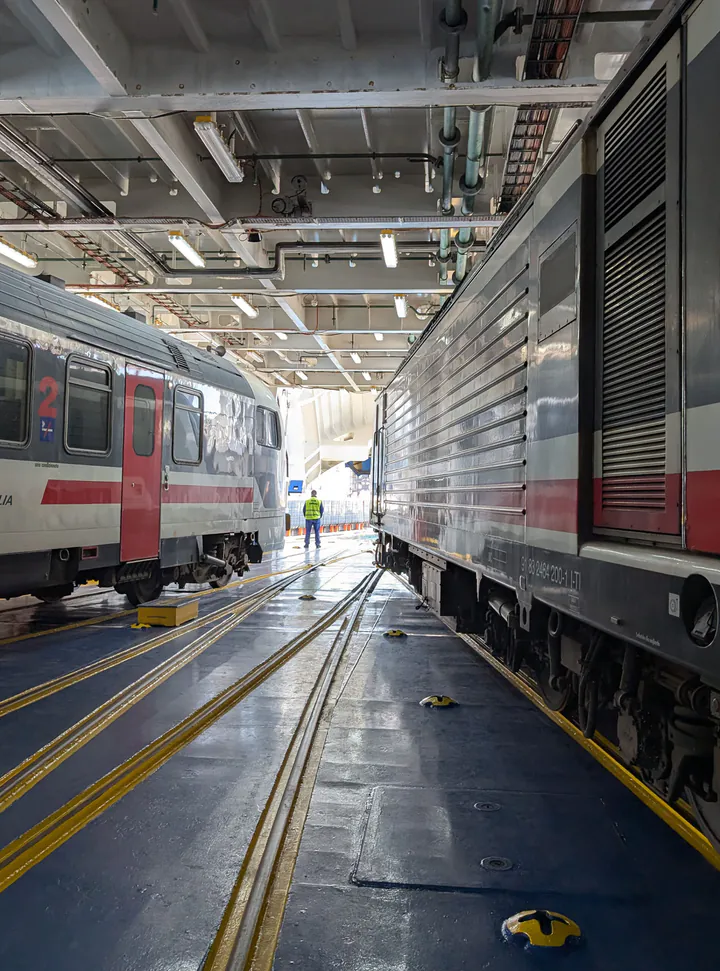
This is the exciting bit! At Villa San Giovanni, the train stopped at the station, then the Palermo and Syracuse parts of the train were uncoupled from each other. We stayed at the station for a few minutes, then slowly we moved forwards and the ship came into view.
Next, we started reversing down towards, and then finally onto the ship, with all of us passengers still in our seats on the train. It’s a very strange experience as you realise the tracks aren’t on land anymore, but on the deck of a ferry.
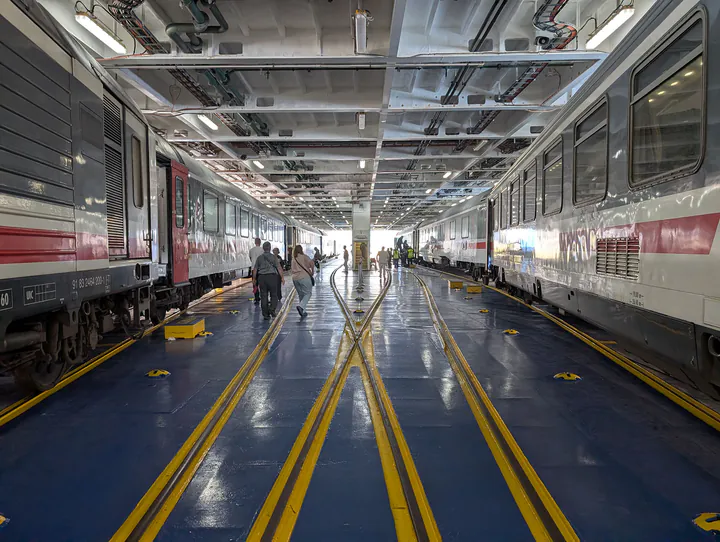
I’d imagined that there would be lots of clanking and metal noises, but it was surprisingly quiet. I can definitely understand how people miss it on the overnight train!
The Palermo section of the train was already lined up next to us on the ferry, so almost as soon as we’d been loaded onto the ship, we set off across the Strait of Messina.
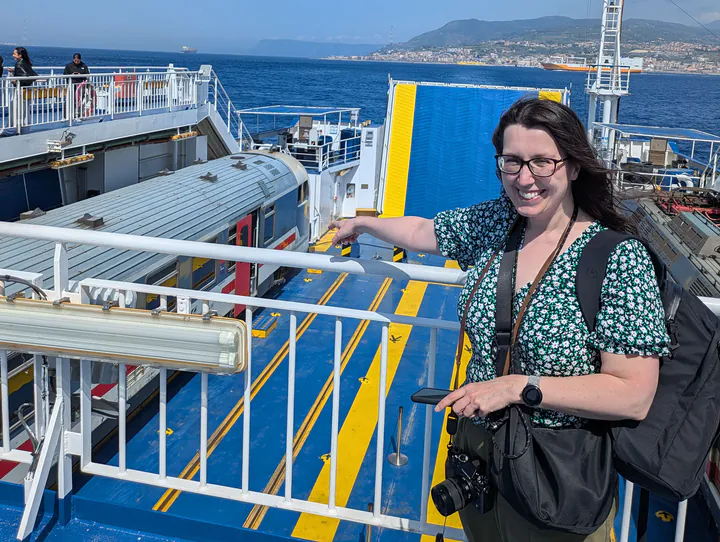
Nobody actually told us that it was ok to get off the train, but we could see people moving about on the deck, so we got off (bringing all our valuables with us, obviously) and went upstairs to see the crossing.
Crossing the Strait of Messina
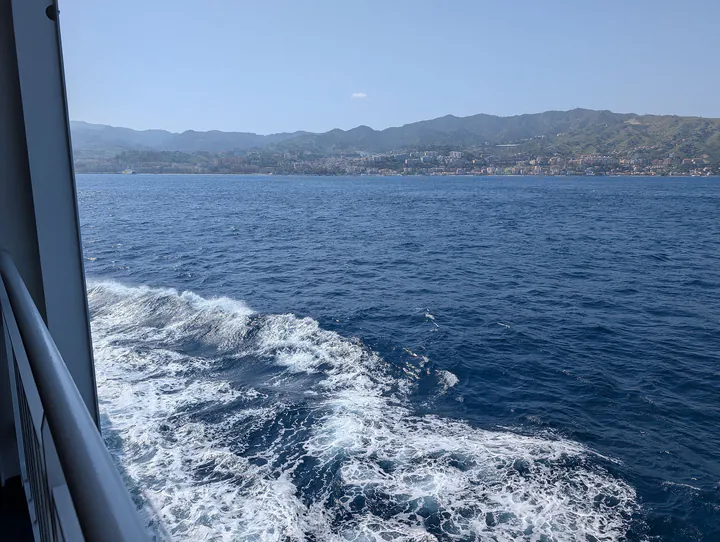
Riding a train onto the deck of a ferry where you’d normally expect to see lorries and cars is very odd, but seeing your train on a boat, crossing the sea, is completely bizarre. The crossing only takes 20 to 30 minutes, but there’s plenty of time to take in the view, with a coffee and pastry from the on-board cafe if you’re quick.
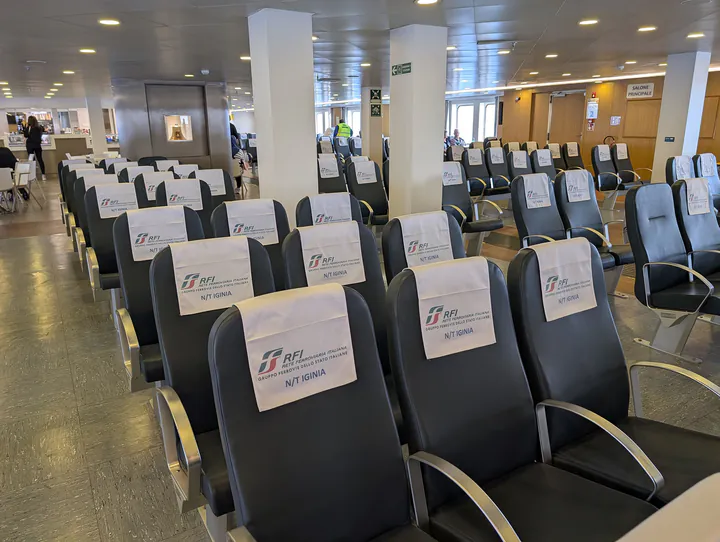
I enjoyed the view on the outside deck, but there are plenty of seats inside if the weather’s bad. Our ship was the Iginia, which was only built in 2022 and runs on a dual-fuel hybrid system – another plus for taking the train from Italy to Sicily rather than flying!
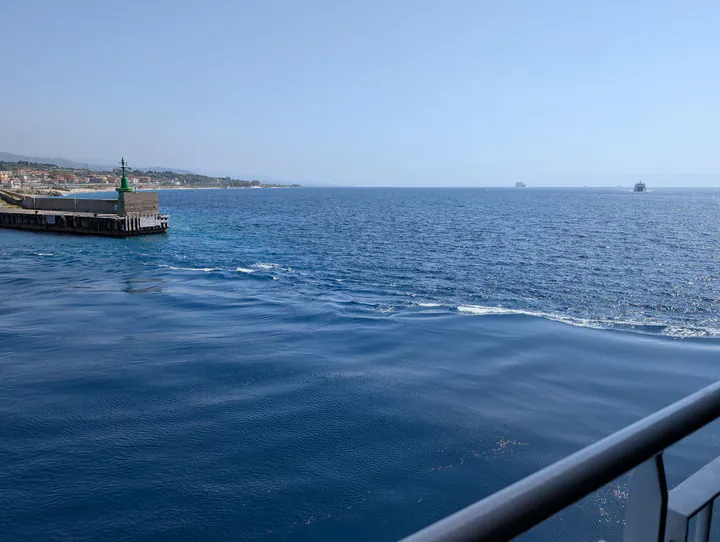
Sailing into Messina’s harbour, you pass beneath the gilded Madonna della Lettera, a statue that’s watched over arrivals since the 1930s.
Just as there aren’t any announcements to tell you that it’s ok to get off the train, there aren’t any to tell you to get back on again. As soon as you see the ship approaching Messina’s harbour, make sure you’re back down on the train deck and in the right carriage, as the train won’t wait for you!
Arriving in Sicily: Messina to Taormina, Catania and Syracuse
Once the ferry docks in Sicily, the train rolls off and reconnects to the tracks on dry land. If you are in the wrong bit of the train, then the short wait at Messina Centrale station is your last chance to fix it before the two sections of train roll off in different directions.
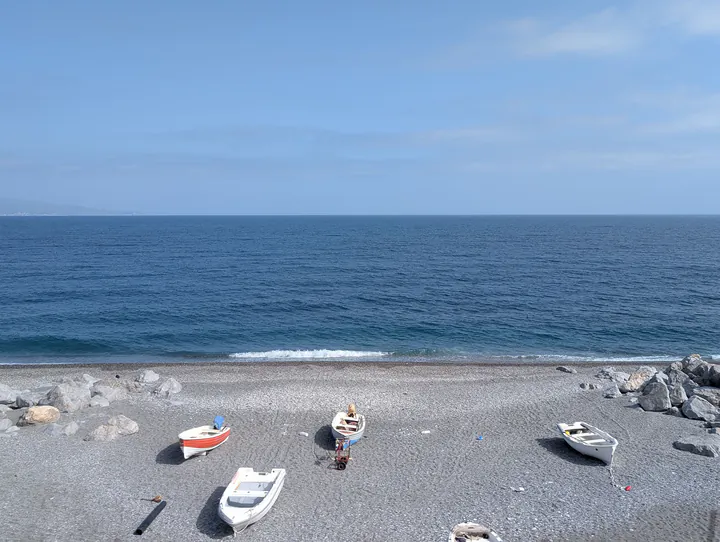
Heading down to Catania and Syracuse, the line hugs the east coast of Sicily, and you can clearly see the toe of Italy across the water.
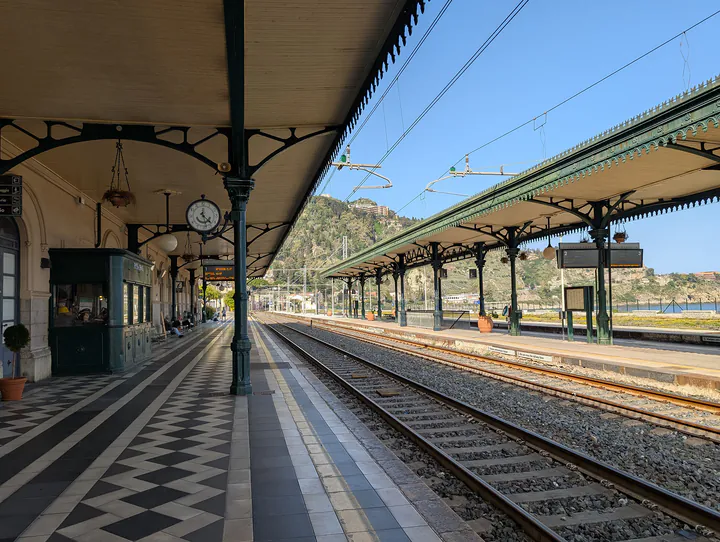
I got off at Taormina-Giardini, and the train arrived precisely on time at the pretty station by the water.
Is taking the train to Sicily worth it?
If you’re travelling between mainland Italy and Sicily, then flying will always be the fastest way to get there, and it might even be cheaper. But if you have the time to spare for a daytime train, or you’re up for the overnight sleeper experience, then taking the train to Sicily is unforgettable.
It’s a long time to spend on a train, and there were definitely parts of the trip that were frustrating, but the train ferry was absolutely amazing. Once a bridge is eventually built, this route will disappear forever, like all the others in Europe – so if you like the sound of it, do it while you still can.
Do you have any questions about taking the train from Italy to Sicily? Let me know in the comments!
If you found this article helpful, you can support my site and see more of my travel guides in your Google results by adding Helen on her Holidays as a preferred source on Google.


Leave a comment